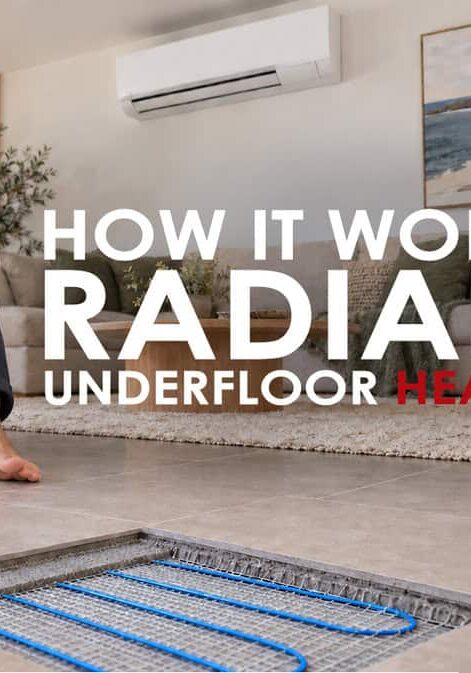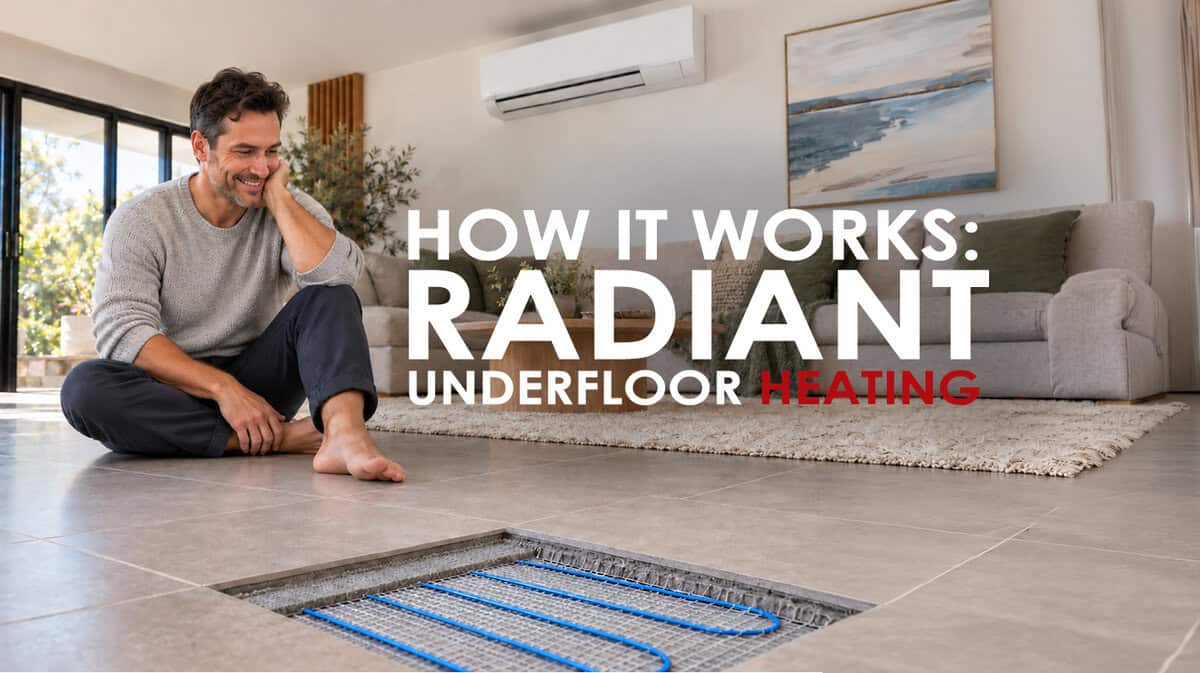
Radiant floor heating warms your home from the floor up. The floor surface gives off heat that warms people, the room and surfaces directly, rather than relying on moving air.
In Australia it is installed as underfloor heating, using either electric cables and mats or hydronic pipes carrying warm water.
Radiant floor heating and underfloor heating are the same thing. "Radiant" describes how the heat reaches you, and "underfloor" describes where the system sits. We use both terms in this guide.
This guide explains how radiant floor heating works, how it compares with ducted, reverse-cycle systems, which type suits your project, and what it costs to install and run.
Table of Contents
- What Is Radiant Floor Heating?
- How Does Radiant Floor Heating Work?
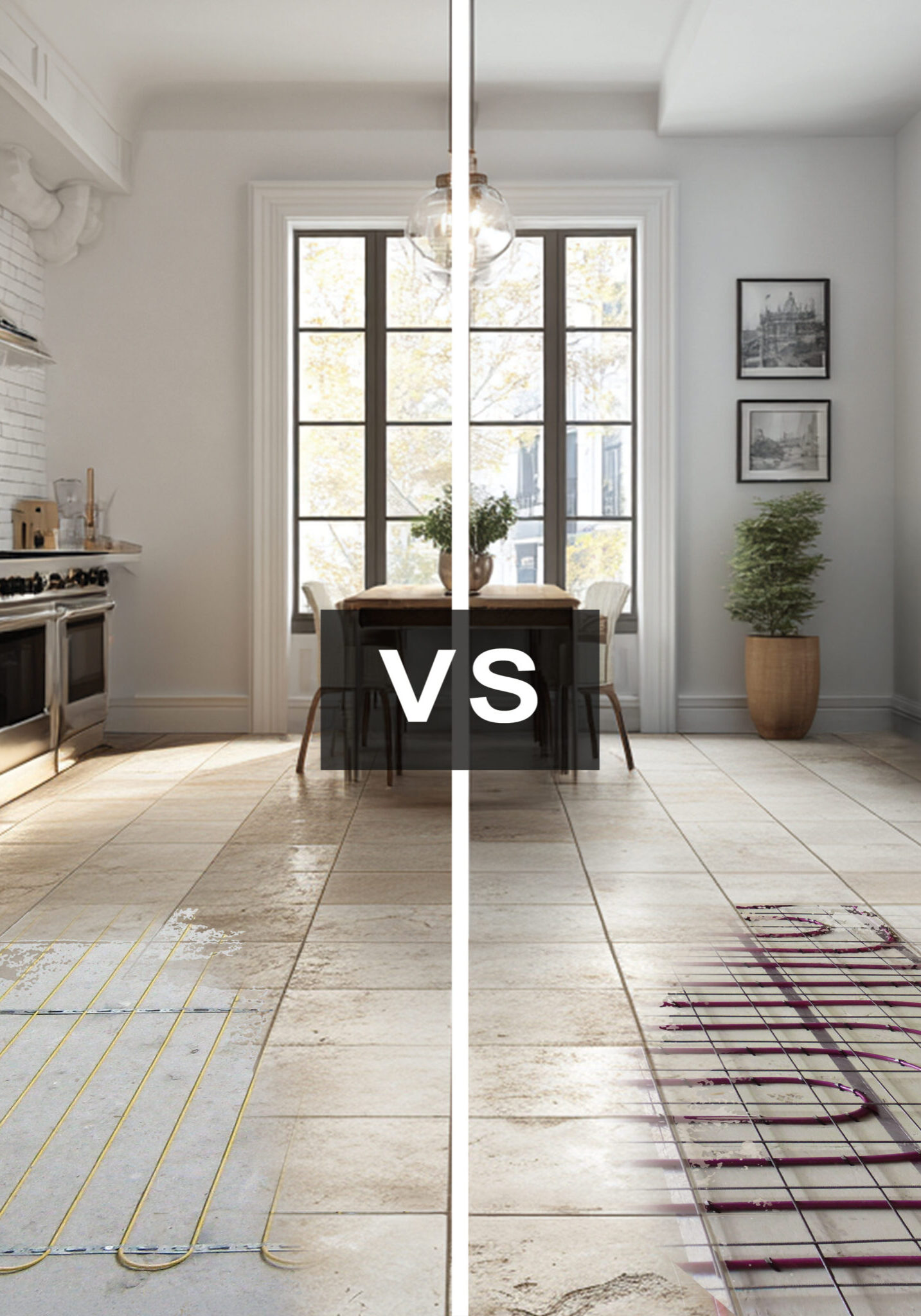
- Radiant Floor Heating vs Ducted and Split-System Heating
- Types of Radiant Floor Heating in Australia
- Which Radiant Floor Heating Suits Your Project?
- Controlling Radiant Heat: Thermostats and Floor Sensors
- What Does Radiant Floor Heating Cost in Australia?
- Radiant Floor Heating, Solar and Thermal Mass
- Is Radiant Floor Heating Right for Your Home?
- Frequently Asked Questions
What Is Radiant Floor Heating?
Radiant heat is warmth that travels as infrared energy from a hot surface to cooler objects, without needing air to carry it. The sun on a crisp winter morning is the everyday example. You feel warm even when the air around you is cold.
A radiant floor system puts that principle underfoot. Heating cables, mats or water pipes sit beneath the floor finish and warm the floor surface to a comfortable temperature. A thermostat and floor sensor keep it there.
The result is gentle, even warmth. There are no vents, no fans and no heater on the wall or ceiling. The system itself creates no air movement, no noise and nothing to see in the room.
How Does Radiant Floor Heating Work?
Every radiant floor system follows the same basic sequence:
- Heat is produced in the floor. An electric cable or mat heats when current passes through it. A hydronic system circulates warm water through pipes, with the water heated by a heat pump or gas boiler.
- The floor surface warms. Heat conducts up through the screed, tile adhesive or slab and the floor covering.
- Radiant heat reaches people and objects. The warm floor heats you, the furniture and the walls directly.
- The air warms as well. Some heat also passes into the room air, so the whole space reaches a steady temperature.
- The thermostat regulates the floor. A floor sensor reports the actual floor temperature, and the thermostat switches the system on and off to hold it.
You may hear that radiant floors work better because "heat rises". Hot air does rise, and radiant floors warm the air too. The practical difference is that you feel warmth from the floor and surfaces around you, not only from warm air that has to be pushed around the room.
Comfort Heat tip: Radiant heat responds more slowly than a blown-air heater. Set your thermostat to switch on 30 to 60 minutes before you need warmth so the floor is comfortable when you walk in.
Smarter Heating Ideas,
Delivered Monthly.
Stay in the construction loop with Comfort Heat Australia. Get practical floor heating advice you can use on your next build or renovation, from design inspiration and installation tips to energy-saving know-how and real Australian projects.
Radiant Floor Heating vs Ducted and Split-System Heating
Most Australian homes use reverse-cycle ducted or split system heating. Here is how radiant floor heating differs:
| Radiant floor heating | Reverse-cycle Ducted heating | Reverse-cycle split system | |
| How heat is delivered | Warm floor surface radiates heat into the room | Warm air blown through vents | Warm air blown from a wall unit |
| Air movement | None from the system | Yes | Yes |
| Equipment in the room | None visible | Vents and grilles | Wall-mounted unit |
| Speed to warm a room | Slower, depending on the system | Heats the air relatively quickly | Heats the air relatively quickly |
| Best suited to | Bathrooms, renovations, new builds and whole-home comfort | Whole-home air heating and cooling | Single rooms heating and cooling |
Radiant floor heating is not automatically the cheapest way to heat a room. The Australian Government's energy.gov.au heating and cooling guide notes that reverse-cycle air conditioning is 300–600% efficient, meaning one unit of electricity can deliver three to six units of heat.
The same page says hydronic radiant systems have high purchase and installation costs, but lower running costs when powered by solar or electric heat pumps.
The case for radiant floors is comfort, silence, no air movement and an invisible installation, with running costs that can be low in the right setting.
Radiant floor heating is a heating solution, so if summer cooling matters, plan for it separately.
For a detailed comparison, read our ducted heating vs underfloor heating guide.
Types of Radiant Floor Heating in Australia
There are two types of radiant floor heating: electric and hydronic. The right choice depends mainly on the size of the area and the stage of your project.
Electric radiant floor heating
Electric underfloor heating uses a heating cable or mats built into the floor. There are no moving parts, and it suits both small rooms and large areas. Comfort Heat offers several electric systems:
- Electric Screed Cable: Cable embedded in a sand and cement screed. A practical option for bathrooms, kitchens, extensions and larger installations.
- Electric Thin Heating Mat: A low-profile mat set in tile adhesive or levelling compound, adding about 7 mm to the floor height. Suits renovations where height is limited.
- Under Timber Electric Mat: Thin foil mats designed for floating timber floors.
- Carpet Heating Mat: Foil mats that sit between the underlay and the carpet.
- Electric Slab Cable: Cable cast into the concrete slab during construction of a new build.
- DIY Electric Kit: A complete kit with a custom design layout, for owner-builders and tradespeople.
Hydronic radiant floor heating
Hydronic underfloor heating circulates warm water through pipes laid in a concrete slab, a sand and cement screed, or beneath timber flooring. Several circuits connect to a central manifold, which controls the flow to each zone.
The water is heated by an air-to-water heat pump or a gas boiler. Comfort Heat recommends the Intaflo heat pump for new installations, given Australia's transition away from gas. It is available in 9, 12, 18, 24 and 30 kW sizes, includes Wi-Fi control and is compatible with solar power.
Hydronic systems need a larger area to make sense. The practical minimum is around 40 m², and 80 m² or more is recommended. A single bathroom is not suitable. The pipe is REHAU PEX with an oxygen barrier, guaranteed for 25 years in cement, and an in-screed system needs about 50 mm of build-up including the pipe.
Electric vs Hydronic at a glance
| Electric | Hydronic | |
| How it heats | Cable or mats in the floor | Warm water through pipes in the floor |
| Best for | Bathrooms, single rooms, renovations and any size area | Whole homes, new builds and large areas |
| Practical size | From a small bathroom upwards | 40 m² minimum, 80 m² or more recommended |
| Heat source | Mains electricity | Intaflo heat pump or gas boiler |
| Warm-up time | About 30 minutes (carpet mats), about 60 minutes (under tile), up to 48 hours (slab) | Slower. Slabs and screeds hold warmth for hours |
| Maintenance | None | Annual heat source service |
For a full side-by-side comparison, read our electric vs hydronic underfloor heating guide.
Not sure whether electric or hydronic suits your project? Use the Comfort Heat Product Finder to find the right system for your floor and room size.
Which Radiant Floor Heating Suits Your Project?
The floor construction usually decides the system. Use this table as a starting point, then confirm the detail with a custom design layout.
| Your project | Suggested system |
| Bathroom with a screed being laid | Electric Screed Cable |
| Bathroom or kitchen retile with limited floor height | Electric Thin Heating Mat |
| Floating or engineered timber floor | Under Timber Electric Mat, or under timber hydronic for larger areas |
| Carpeted bedroom or living area | Carpet Heating Mat |
| New build with a concrete slab | Electric Slab Cable, or hydronic slab for 80 m² and above |
| Whole home or major renovation with floors being rebuilt | Hydronic in-screed with the Intaflo heat pump |
| Owner-builder or licensed trade | DIY Electric or DIY Hydronic Kit |
Radiant floor heating works under tile, stone, vinyl, laminate, cork, polished concrete, carpet and floating timber.
Dense coverings such as porcelain tile hold warmth well. Thick or heavily insulating coverings placed directly over the heating can reduce its output, so your design team will check compatibility for your chosen floor. Our guide to the best flooring for underfloor heating covers the options in more detail.
If you are renovating, the easiest time to add radiant floor heating is while the old floor is up. Read our renovation and retrofit guide and our bathroom guide for room-specific advice.
Controlling Radiant Heat: Thermostats and Floor Sensors
Because a floor warms and cools gradually, good control makes a real difference to comfort and running cost. Comfort Heat thermostats are designed for underfloor heating and use floor-sensor control.
The floor sensor sits beneath the floor surface and measures the actual floor temperature in real time. This keeps the floor consistent and helps protect sensitive coverings such as timber from overheating.
Comfort Heat's thermostat range has three models:
- MWD5 Programmable: Wi-Fi control from your phone, with a 7-day, 4-event temperature and time schedule.
- MCD3 Standard: A reliable entry-level controller with fixed temperature selection or basic programming, and no Wi-Fi.
- ETN4 Home Automation: Integrates with a home automation system, with floor-sensor control and setback functions.
Slab and screed systems respond slowly, so they are not scheduled in short bursts like a thin mat under tile. Your design team can advise on the best operating pattern for your floor.
What Does Radiant Floor Heating Cost in Australia?
Installation cost
Costs depend on the system, the area, whether you are renovating or building new, and your location. These are the indicative supply and installation ranges from our underfloor heating cost guide, current for 2026:
| System | Approx. cost (supply + install) | Notes |
| Thin Heating Mat (electric) | $120 per m² | Tile renovations |
| Electric Screed Cable | $80 per m² | Bathrooms, kitchens, extensions |
| Carpet Heating Mat | $80 per m² | Bedrooms, living areas |
| Under Timber Electric Mat | $80 per m² | Floating timber floors |
| Electric Slab Cable | $60 per m² | New builds |
| Hydronic In-Screed | $160 per m² | Heat Pump system |
| Hydronic In-Slab | $150 per m² | Heat Pump system |
| Intaflo Series 3 Heat Pump | From about $6,000–$12,000 installed | Size dependent |
Electric figures include a programmable thermostat. A typical 3 m² bathroom with a screed cable costs around $600 for a DIY kit or $900 fully installed.
Running cost
Electric radiant floor heating costs depending on your tariff, floor covering, insulation and hours of use.
A 3m² bathroom heated for four hours a day costs about $1 a day.
Hydronic systems paired with the Intaflo heat pump achieve a coefficient of performance (COP) of around 3.45, delivering 3.45 units of heat for each unit of electricity.
Want a running cost estimate for your home? Use the Comfort Heat Floor Heating Cost Calculator to enter your floor area, tariff and hours of use.
Radiant Floor Heating, Solar and Thermal Mass
A concrete slab acts as thermal mass. The Australian Government's Your Home guide explains that thermal mass absorbs heat during the day and re-radiates it back into the home through the night. A hydronic slab, or a screed with in-floor heating, uses the same principle.
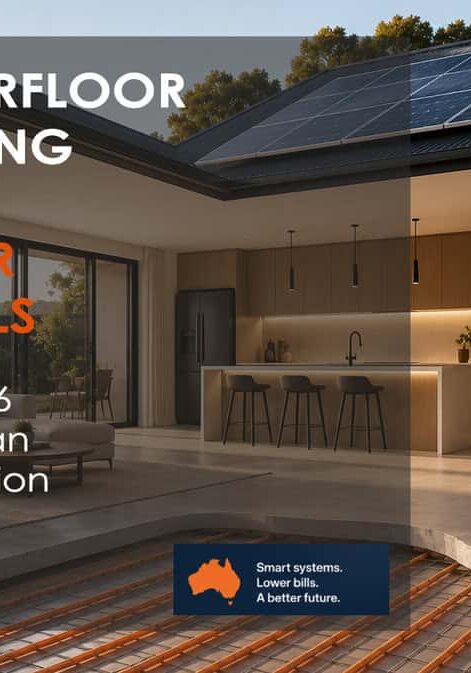
With rooftop solar, you can pre-heat the floor during peak generation, roughly 10am to 3pm, and let the floor hold warmth into the evening. The larger the solar system and the more thermal mass, the greater the benefit. Our solar integration guide explains how to schedule it.
Insulation matters with slabs. Your Home notes that the National Construction Code requires slab-edge insulation when in-slab heating is installed, so confirm the current requirements with your builder or designer. Read why in our guide to insulation under a heated slab.
Is Radiant Floor Heating Right for Your Home?
Radiant floor heating is a strong fit when:
- You are renovating a bathroom, kitchen or living area and the floor is already open.
- You are building new and can include a slab or screed system from the start.
- You want warm floors with no air movement, no vents and no visible heater.
- You want a system that controls floor temperature precisely, room by room.
It may not be the best choice when:
- You only need quick heat in a room used for an hour or two. A split system heats air faster.
- The area is small and you are considering hydronic. Electric is the better option below about 40 m².
- You do not want to lift an existing finished floor. Retrofitting is easiest when the floor is being replaced.
If our solution is not the right fit, we will tell you. The energy.gov.au guide also recommends seeking expert advice before a major investment such as an in-slab system. All electrical connections must be completed by a licensed electrician.
Ready to make the switch to healthier heating?
Contact Comfort Heat for a free consultation and a custom design layout for your home.
Frequently Asked Questions
What is radiant floor heating?
Radiant floor heating warms a home through the floor. Electric cables or mats, or hydronic pipes carrying warm water, heat the floor surface, which then warms people and objects in the room directly. It creates no air movement, noise or visible equipment, and is controlled by a thermostat with a floor sensor.
Is radiant floor heating the same as underfloor heating?
Yes. Radiant floor heating describes how the heat reaches you. Underfloor heating describes where the system is installed. Both terms refer to electric or hydronic systems built into or beneath the floor, and Comfort Heat designs, supplies and installs both types across Australia.
Is radiant floor heating electric or hydronic?
It can be either. Electric systems use a cable or foil mat and suit bathrooms, single rooms and renovations. Hydronic systems circulate warm water from a heat pump or gas boiler and suit whole homes and large areas, with 80 m² or more recommended.
How long does radiant floor heating take to warm up?
It depends on the system. Carpet mats take about 30 minutes, under-tile systems about 60 minutes, and slab heating up to 48 hours from cold. A programmable thermostat lets you switch the system on early so the floor is ready when you need it.
Does radiant floor heating work under timber, carpet and tiles?
Yes. Comfort Heat systems suit tile, stone, vinyl, laminate, cork, polished concrete, carpet and floating timber. Dedicated carpet and under timber products are available, and a floor sensor helps protect timber from overheating. Your custom design layout will confirm compatibility with your chosen covering.
Can radiant floor heating be installed in an existing home?
Yes, and electric systems make it practical. Thin mats add about 7 mm to the floor height, and carpet mats sit under the carpet. It is easiest during a renovation when the floor is already being lifted. Hydronic retrofits usually need the floor to be rebuilt. without any safety concern.
Is radiant floor heating better than reverse-cycle air conditioning?
Neither is better for every home. Reverse-cycle systems are very efficient and also provide cooling. Radiant floors deliver silent, even warmth with no air movement and nothing visible. Many homes use radiant heating in bathrooms and living areas, with a split system for cooling.
Ready to find out more?
Every great project starts with a conversation. Talk to the team here at Comfort Heat today for honest, expert advice on heating your bathroom.